
The Best Multivitamin for GLP-1 Users: What to Look For (and What to Skip)
On Ozempic, Wegovy, Mounjaro, or Zepbound you eat far less food — which means far fewer vitamins and minerals, even when your weight loss is going perfectly. Here's exactly which nutrients GLP-1 users run short on, the forms and doses that actually absorb on a small-volume diet, what to skip, and how to time a multivitamin so it doesn't make nausea worse.

A GLP-1 medication works largely by shrinking how much food you want. That is the point — and it is also the problem nobody mentions at the prescribing appointment. If you were eating 2,200 calories a day and you are now comfortably full at 1,100, you did not just halve your calories. You halved your vitamin B12, your iron, your magnesium, your potassium, your zinc, your vitamin D, and every other micronutrient that used to arrive inside that food.
This is why so many people on Ozempic, Wegovy, Mounjaro, and Zepbound describe the same cluster of complaints at month two or three: flat energy, brittle nails, more hair in the shower drain, cramping calves at night, bruising easily, foggy afternoons. The scale is moving. The labs, quietly, are drifting.
A multivitamin is not a magic fix and it is not a replacement for protein or real food. But on a small-volume diet it is the single cheapest form of insurance you can buy. The catch is that most multivitamins on the shelf were designed for someone eating three full meals a day, with cheap mineral forms that need a large, acidic, food-filled stomach to absorb — the exact stomach a GLP-1 user no longer has. This guide covers what a GLP-1-appropriate multivitamin should actually contain, which forms absorb on a light stomach, what to leave out, and how to time it so it does not trigger nausea.
Short answer: what the best multivitamin for GLP-1 users looks like
- Methylated B-complex — methylcobalamin B12 (not cyanocobalamin) and methylfolate, because B vitamins are the first thing to fall when food volume drops.
- Vitamin D3 with K2 — D3 1,000–2,000 IU with 45–90 mcg K2 (MK-7); low vitamin D is the most commonly flagged deficiency in weight-loss populations.
- Chelated minerals — magnesium glycinate, zinc picolinate or bisglycinate, iron bisglycinate if iron is included. Chelated forms absorb without needing a big acidic meal and are far gentler on the stomach.
- Meaningful magnesium and potassium — most multis include a token 25 mg of magnesium, which does nothing for cramps or regularity.
- Skin, hair, and nail cofactors — biotin, vitamin C, and zinc, which support the protein structures that suffer most during rapid weight loss.
- Capsules or powder over large horse-pill tablets — easier to get down when stomach volume is small and gastric emptying is slow.
- No megadoses of fat-soluble vitamins, no proprietary stimulant blends, no undisclosed 'fat burner' complexes.
Why GLP-1 users need a different multivitamin than everyone else
Three things change at once on a GLP-1, and each one independently affects nutrient status.
- Food volume collapses. Micronutrient intake is roughly proportional to calories eaten. Cut intake by 40–50% for six months and you are running a sustained deficit on nearly every vitamin and mineral, regardless of how 'clean' the food is.
- Gastric emptying slows. Food and pills sit in the stomach longer. Large tablets and harsh mineral salts (magnesium oxide, ferrous sulfate, zinc oxide) are far more likely to cause nausea, reflux, and sulfur burps in this state.
- Protein and produce get crowded out. When you can only eat a small amount, most people default to whatever is easiest — which is rarely leafy greens, legumes, or oily fish. Potassium, magnesium, folate, and omega-3s are the first casualties.
- Fluid and electrolyte turnover rises. Reduced eating means reduced sodium and potassium intake, plus real fluid loss if there is any vomiting or loose stool during titration.
The nutrients GLP-1 users run short on most
- Vitamin B12 — central to energy metabolism and nerve function. Low B12 presents as fatigue, tingling hands or feet, and brain fog. Use methylcobalamin; it does not depend on the conversion step cyanocobalamin needs.
- Vitamin D — widely under-replete even before weight loss. Matters for immune function, mood, and bone density, which becomes relevant when body weight drops quickly.
- Magnesium — involved in 300+ enzymatic reactions. Deficit shows up as night cramps, restless sleep, headaches, constipation, and eye twitches. Glycinate is the form that absorbs well and does not send you to the bathroom.
- Potassium — the most under-consumed electrolyte on a low-volume diet. Low potassium contributes to weakness, cramping, and heart-rate flutters. Multivitamins can only legally carry a small amount, so food and electrolytes carry the rest.
- Iron — especially for menstruating women. Low ferritin is one of the most common reasons fatigue and hair shedding persist even when protein is adequate. Iron bisglycinate is dramatically gentler than ferrous sulfate.
- Zinc — needed for wound healing, taste perception, immune defense, and hair follicle health. Low zinc plus rapid weight loss is a bad combination for hair.
- Protein-adjacent nutrients — biotin, vitamin C, and selenium support the keratin and collagen structures in hair, skin, and nails during a period when the body is deprioritizing them.
- Omega-3 (EPA/DHA) — rarely in a multivitamin, but worth adding separately if you are not eating oily fish twice a week.
Nutrient forms that actually absorb on a GLP-1 (a cheat sheet)
- Magnesium: choose glycinate, malate, or citrate. Avoid oxide — poorly absorbed and a common cause of loose stool.
- B12: choose methylcobalamin. Avoid relying solely on cyanocobalamin.
- Folate: choose methylfolate (5-MTHF) over folic acid.
- Zinc: choose picolinate or bisglycinate. Avoid zinc oxide.
- Iron: choose bisglycinate (ferrous bisglycinate). Avoid ferrous sulfate if you have any nausea or constipation.
- Vitamin D: choose D3 (cholecalciferol) paired with K2 as MK-7, not D2.
- Vitamin E: choose mixed tocopherols over synthetic dl-alpha-tocopherol.
- Calcium: choose citrate over carbonate — carbonate needs stomach acid and a full meal to absorb.
What to skip in a multivitamin while on a GLP-1
- Megadose fat-soluble vitamins. Vitamin A above roughly 5,000 IU as retinol and very high vitamin E are unnecessary and accumulate. Beta-carotene forms are safer.
- Stimulant or 'metabolism' blends. Caffeine, synephrine, yohimbe, or green tea extract at high doses stack badly with the elevated heart rate and reduced food intake some people already experience.
- Huge iron doses without a lab. Iron is essential if you are low and irritating if you are not. Test ferritin rather than guessing.
- Gummies as your only multivitamin. Most gummies drop iron and magnesium entirely, carry added sugar, and underdose everything else.
- Massive oversized tablets. If it is hard to swallow and sits in your stomach, you are more likely to skip it — and adherence beats theoretical perfection.
- Proprietary blends with no per-ingredient amounts. If the label will not tell you the dose, you cannot evaluate it.
- Anything claiming to 'boost GLP-1' or 'replace' your medication. No supplement does that.
When to take a multivitamin on a GLP-1 (timing that prevents nausea)
- Take it with your largest meal of the day, whichever one that is. Fat-soluble vitamins (A, D, E, K) need some dietary fat, and food buffers minerals against stomach irritation.
- Never take it on an empty stomach. This is the single most common reason people say a multivitamin 'made them sick' on a GLP-1.
- If your appetite is best in the morning, take it at breakfast. If evenings are easier, take it at dinner — consistency matters more than the clock.
- Split the dose if the label allows. Two capsules with two different meals is easier on the stomach and improves absorption of minerals that compete with each other.
- Separate magnesium and calcium from iron by at least 2 hours; they compete for the same transporters.
- On injection day, if nausea peaks 24–72 hours after your shot, take the multivitamin on your best-feeling day rather than forcing it through the worst window.
- Pair it with protein and electrolytes rather than treating it as a standalone fix — a multivitamin covers micronutrients, not your 1.2–1.6 g/kg protein target or your sodium and potassium needs.
What a multivitamin will not do
A multivitamin fills micronutrient gaps. It does not supply protein, fiber, fluid, or electrolytes in the amounts a GLP-1 user needs, and it will not fix symptoms that are being driven by under-eating.
If you are fatigued, the first questions are protein intake, total calories, hydration, and ferritin — not whether your multivitamin has enough B6. If you are constipated, the answer is fiber, fluid, and magnesium glycinate at meaningful doses. If you are cramping, it is usually sodium, potassium, and magnesium, which a multi alone cannot cover. Think of the multivitamin as the floor beneath the stack, not the stack itself.
How this fits into a complete GLP-1 support stack
- Protein first: 1.2–1.6 g per kg of body weight daily to protect lean muscle during rapid weight loss.
- Electrolytes daily: sodium, potassium, and magnesium to cover the headaches, dizziness, and cramping that come from lower food and fluid intake.
- Fiber: 25–35 g daily, ramped slowly with plenty of water, for regularity and appetite steadiness.
- Magnesium glycinate at night: 200–400 mg for sleep, regularity, and cramp prevention.
- Digestive support: enzymes or a gentle motility aid if bloating and fullness are your dominant symptoms.
- A GLP-1-appropriate multivitamin: the background insurance policy for everything the smaller plate no longer delivers.
Labs worth asking your provider about at month 3–6
- Ferritin and a complete blood count — the highest-yield test for persistent fatigue and hair shedding.
- Vitamin B12 (and methylmalonic acid if B12 is borderline).
- 25-hydroxy vitamin D.
- A basic metabolic panel including potassium, sodium, and magnesium.
- Thyroid panel if fatigue is severe and not explained by intake.
- Bring your supplement labels to the appointment — dose matters, and your provider can tell you what to adjust.
Frequently asked questions
- Do I really need a multivitamin on a GLP-1? If you are eating substantially less food than before, a multivitamin is sensible low-cost insurance. It does not replace protein, fiber, or electrolytes.
- What is the best multivitamin for GLP-1 users? One with methylated B vitamins, D3 with K2, chelated minerals (magnesium glycinate, zinc picolinate or bisglycinate), meaningful magnesium, and no stimulant or proprietary blends — taken with food.
- Should my multivitamin contain iron? Only if you are low or menstruating. Ask for a ferritin test rather than guessing, and choose iron bisglycinate if you do supplement.
- Can a multivitamin cause nausea on Ozempic? Yes, especially on an empty stomach or with harsh mineral forms like magnesium oxide, zinc oxide, and ferrous sulfate. Take it with your biggest meal and switch to chelated forms.
- Is a gummy multivitamin enough? Usually not — most omit iron and magnesium and underdose the rest. Capsules or a powder are a better fit.
- Will a multivitamin stop GLP-1 hair loss? Hair shedding during rapid weight loss is mostly telogen effluvium and usually resolves in 6–9 months. Adequate protein, iron, zinc, and vitamin D give the follicle the raw materials it needs; a multivitamin helps cover those, but protein intake matters more.
- Can I take a multivitamin with my GLP-1 injection? Yes — there is no interaction with the injection itself. Time it around your appetite, not your shot.
- How long should I take it? For as long as your food volume is meaningfully reduced, which for most people means the entire time they are on the medication and through maintenance.
Related guides
Medication guides mentioned in this article
Related tools
Supplements built for your GLP-1 journey
Formulated for the exact nutrient gaps GLP-1 medications create — protein, electrolytes, magnesium, digestive support, and more. Trusted by thousands staying strong, energetic, and healthy on Ozempic, Wegovy, Mounjaro, and Zepbound.
Continue reading
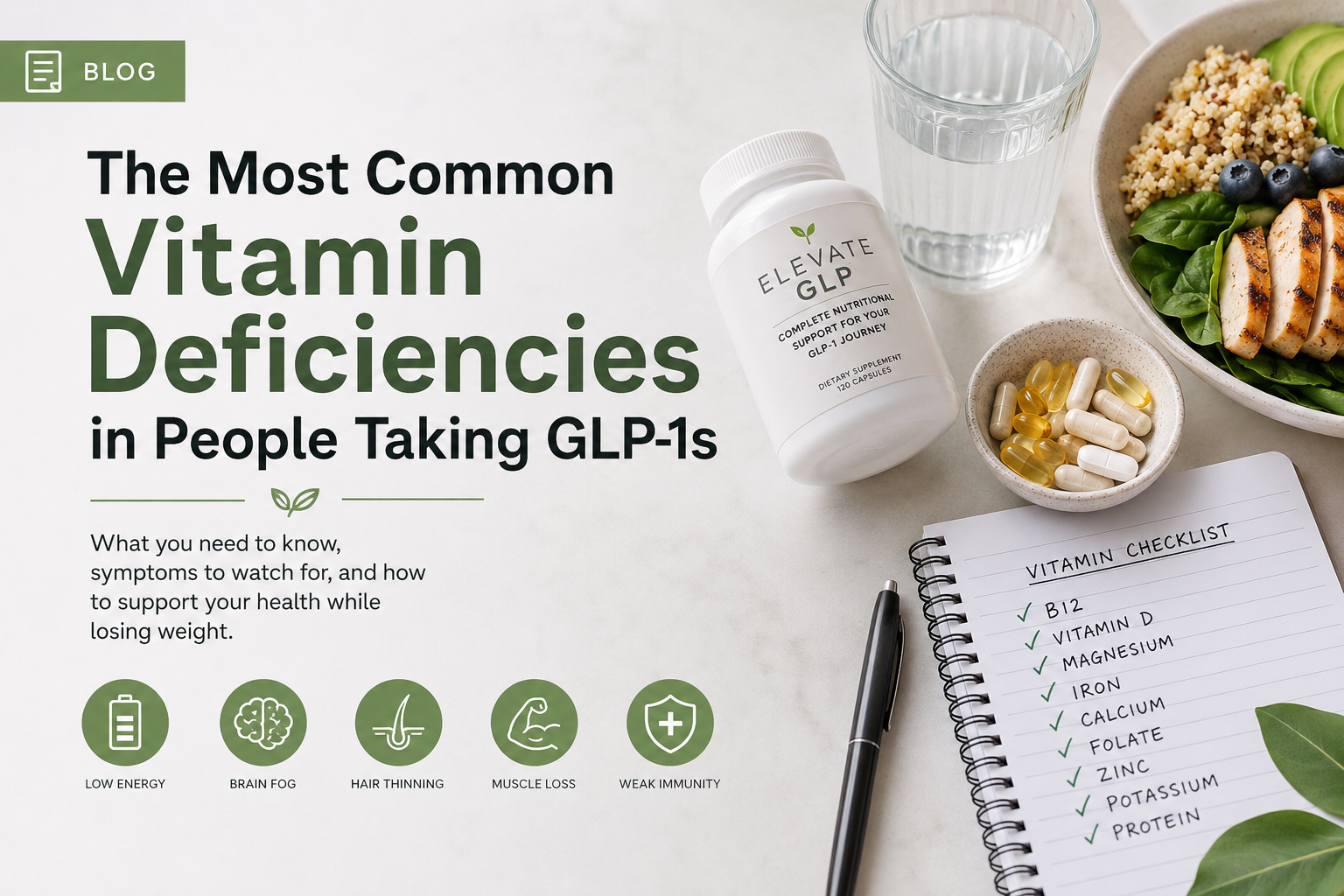
The Most Common Vitamin Deficiencies in People Taking GLP-1s

What to Eat When You're Not Hungry on GLP-1: 15 Small, Protein-Rich Meals

What to Eat on GLP-1 Medications: 25 Foods That Are Easy on Your Stomach

Best Over-the-Counter GLP-1 Supplements (2026): What Actually Helps