
GLP-1 Vitamins: The Daily Supplements Worth Taking (and Why)
Eating 30–50% less food on Ozempic, Wegovy, Mounjaro, or Zepbound means 30–50% fewer vitamins and minerals arriving every day. Here is exactly which daily supplements GLP-1 users benefit from most, the doses that matter, when to take each one, and what you can safely skip.
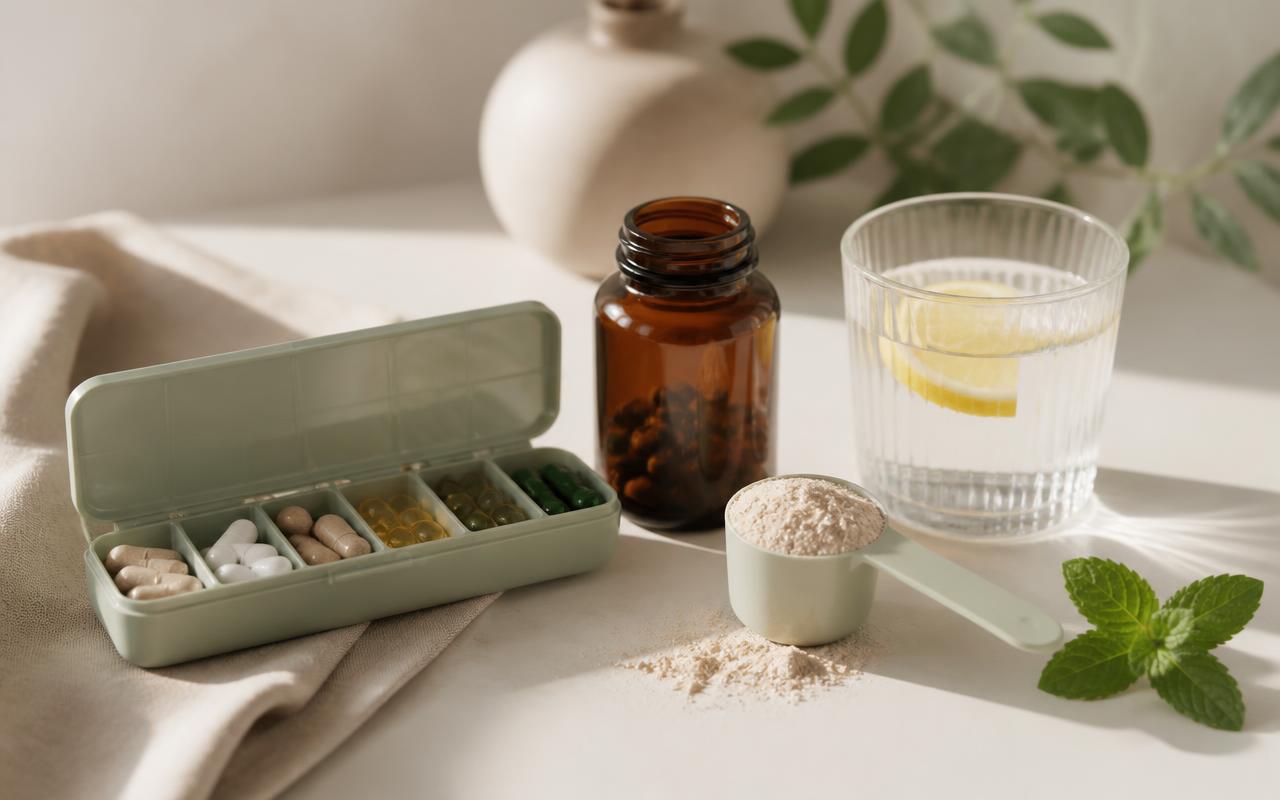
GLP-1 medications work by making you eat less. That is the entire point — and it is also the reason a daily supplement routine matters more on Ozempic, Wegovy, Mounjaro, or Zepbound than it ever did before. When food volume drops 30–50%, so does every nutrient that used to arrive inside that food: protein, sodium, potassium, magnesium, B12, iron, vitamin D, and fibre all fall together, quietly, at the same time.
Most of what people call 'medication side effects' — the 3 p.m. crash, night cramps, constipation, thinning hair, brain fog, feeling cold, losing strength in the gym — track far more closely with those nutrient gaps than with the drug itself. The medication creates the gap. Daily supplementation closes it.
This guide covers the seven daily supplements that earn their place for GLP-1 users, the dose range for each, when in the day to take them, which ones are optional, which ones are genuinely a waste of money, and how to build the whole thing into a routine you will actually keep for the 12–18 months you are likely on the medication.
Short answer: the daily GLP-1 supplement stack
- Protein — 25–40 g from a supplement to reach 1.2–1.6 g per kg of body weight daily; the single highest-impact item for protecting muscle.
- Electrolytes — one low-sugar serving daily (roughly 500–1,000 mg sodium, 200–400 mg potassium) to fix the headaches, dizziness, and fatigue that plain water cannot.
- Magnesium glycinate — 200–400 mg elemental at night for cramps, sleep, and regularity.
- A complete multivitamin — daily insurance for B12, D, K2, folate, iron, and zinc that a half-sized diet no longer covers.
- Fibre — 5–10 g daily, started low and increased slowly, for the constipation almost every GLP-1 user meets.
- Digestive support — enzymes or a low-dose probiotic if you get bloating, sulfur burps, or heaviness after meals.
- Creatine monohydrate — 3–5 g daily, optional but well-supported for holding onto strength and lean mass during rapid weight loss.
- Take fat-soluble items (multivitamin, D, K2) with the meal containing the most fat, and keep magnesium and fibre away from iron and thyroid medication by 2–4 hours.
Why daily supplements matter more on a GLP-1
There are four separate mechanisms at work, and they compound.
First, sheer volume. Vitamins and minerals are not concentrated in a magic corner of your plate — they are spread across everything you eat. Cut portions in half and you cut intake of nearly every micronutrient roughly in half too. A diet that was adequate at 2,200 calories is quietly deficient at 1,200.
Second, food choices narrow. When appetite is low, most people gravitate to the few things that stay tolerable: toast, crackers, yoghurt, broth, a protein shake. Those foods are gentle but nutritionally thin. The nutrient-dense items — red meat, leafy greens, legumes, oily fish, nuts — are often the first casualties because they feel heavy on a slow stomach.
Third, absorption changes. Slower gastric emptying alters how and when nutrients arrive in the small intestine, and reduced stomach acid over time can blunt absorption of B12, iron, magnesium, and calcium in particular. Taking less in while absorbing a smaller fraction of it is a double hit.
Fourth, losses go up. Nausea, vomiting, and loose stools around dose escalations flush out fluid and electrolytes. Rapid fat loss also increases the body's demand for the cofactors it uses to remodel tissue — protein, B vitamins, magnesium, and zinc among them.
None of that means the medication is doing something wrong. It means a smaller diet needs a denser one, and daily supplementation is the most reliable way to get there when appetite will not cooperate.
1. Protein: the non-negotiable
If you take one supplement on a GLP-1, take protein. Research on rapid weight loss consistently finds that a meaningful share of what comes off can be lean tissue rather than fat when protein intake and resistance training are inadequate. Losing muscle lowers resting metabolism, which makes maintenance harder later — the exact outcome you do not want after a year of effort.
The target most clinicians work toward is 1.2–1.6 g of protein per kilogram of body weight per day, weighted toward the higher end if you are training or over 50. For an 80 kg person that is roughly 95–130 g daily. Hitting that from whole food alone while eating half your previous volume is genuinely difficult; a 25–40 g shake does in three minutes what a chicken breast cannot when you are full after four bites.
Timing matters less than total, but front-loading helps. Appetite is usually best in the morning, so a shake at breakfast banks 30 g before nausea or fullness has a chance to derail the day. Spreading protein across 3–4 servings also supports muscle protein synthesis better than a single large dose.
- Aim for 1.2–1.6 g per kg of body weight daily; use a shake to cover whatever food leaves short.
- Choose a formula that mixes thin rather than thick — heavy, creamy shakes are hard to finish on a slow stomach.
- Pair protein with resistance training 2–3 times weekly; the supplement only protects muscle you are also using.
- Use our protein calculator to get your exact daily number rather than guessing.
2. Electrolytes: the fastest symptom win
Roughly 80% of dietary sodium, most potassium, and a large share of magnesium arrive inside food. Eat far less food and all three drop, which is why so many GLP-1 users describe headaches, lightheadedness when standing, heart flutters, and a heavy fatigue that sleep does not touch — while drinking plenty of water.
Plain water without minerals can make this worse, diluting what little sodium remains. A daily low-sugar electrolyte serving is often the single change that makes people say they feel human again, usually within a day or two.
Double up on injection day, on hot days, and any day with vomiting or diarrhea. Look for real doses — roughly 500–1,000 mg sodium and 200–400 mg potassium per serving — and skip anything loaded with sugar, which will sit badly on a slow stomach.
3. Magnesium: cramps, sleep, and regularity
Magnesium is involved in hundreds of enzymatic reactions, including muscle relaxation, nerve signalling, and bowel motility. It is also one of the most commonly under-consumed minerals even in people eating normally, which makes a reduced-intake diet a near-guarantee of falling short.
The form matters more than the number on the front of the bottle. Magnesium glycinate is gentle, well absorbed, and calming — the right default for GLP-1 users, especially taken at night. Magnesium citrate is more laxative, which can help if constipation is the dominant complaint. Magnesium oxide is cheap and poorly absorbed; it mostly draws water into the bowel.
Target 200–400 mg of elemental magnesium daily, taken in the evening. Most people notice fewer night cramps, easier sleep, and more predictable bowel movements inside a week.
4. A complete multivitamin: your insurance policy
A multivitamin is not exciting, and it is not a substitute for food. What it does is stop small gaps from becoming symptoms across a 12–18 month course of treatment. On a half-sized diet, the risk is not one dramatic deficiency — it is six or seven modest ones stacking into fatigue, hair shedding, poor recovery, and low mood.
The nutrients that matter most for this population: B12 and folate (energy, nerve function, and often low when stomach acid falls), vitamin D with K2 (bone density, which is a real concern during rapid weight loss), iron (hair, energy, and frequently low in women), zinc (hair, skin, and immune function), and the full B-complex used to convert food into usable energy.
Choose bioavailable forms — methylcobalamin over cyanocobalamin, methylfolate over folic acid, D3 rather than D2 — and take it with the meal containing the most fat so the fat-soluble vitamins are actually absorbed. Taking a multivitamin on an empty, slow stomach is also the most common cause of supplement-related nausea.
5. Fibre: for the constipation nearly everyone gets
Slower gastric emptying, less food, and less fluid make constipation close to universal on GLP-1 medications. Fibre helps, but the details decide whether it helps or makes things worse.
Start low — 3–5 g daily — and increase over two to three weeks toward 5–10 g from a supplement, on top of whatever food provides. Adding a large dose on day one to an already sluggish gut reliably produces bloating and gas. And fibre without fluid is counterproductive: every serving needs a full glass of water behind it.
Soluble fibre such as psyllium is usually the better tolerated choice, softening stool rather than simply adding bulk. If constipation persists past a couple of weeks of adequate fibre, fluid, magnesium, and movement, that is a conversation with your provider rather than a reason to keep escalating the dose.
6. Digestive support: if meals feel heavy
Not everyone needs this one. But if you get bloating within an hour of eating, sulfur burps, reflux, or the sense that a small meal is still sitting there three hours later, digestive support is worth a two-week trial.
Digestive enzymes help break down protein and fat that a slowed system is processing less efficiently — take them with the first bites of your largest meal, not afterwards. A low-dose, multi-strain probiotic can help with gas and irregularity, though give it three to four weeks before judging it.
Keep the trial clean: add one thing at a time so you know what worked. Stacking four new products in the same week tells you nothing.
7. Creatine: optional, but well supported
Creatine monohydrate is one of the most studied supplements in existence, and its main benefit — preserving strength and lean mass — lines up almost perfectly with the main risk of rapid GLP-1 weight loss.
The protocol is simple: 3–5 g daily, every day, no loading phase required, timing irrelevant. Monohydrate is the form with the evidence behind it; the expensive variants offer no proven advantage.
Expect an early 1–2 kg increase on the scale from water drawn into muscle. That is not fat gain, and knowing it in advance stops it from derailing your week. Creatine works best alongside resistance training and adequate protein — it is an amplifier, not a replacement.
What you can skip
- 'Natural GLP-1 boosters' — berberine, apple cider vinegar, and similar products marketed as alternatives do not replicate what your prescription does, and stacking them adds cost and GI upset without benefit.
- Megadose single vitamins without a tested reason — more is not better, and fat-soluble vitamins A, D, E, and K accumulate. Test, then dose.
- High-sugar electrolyte or meal-replacement drinks — the sugar load sits badly on a slow stomach and works against the medication.
- Thick, ultra-creamy protein shakes — nutritionally fine, but most people quietly abandon them within two weeks because they are hard to finish.
- Appetite stimulants or 'metabolism boosters' — unnecessary, and often stimulant-heavy on top of a medication that already affects heart rate.
A simple daily schedule that sticks
- Morning, with your first food: complete multivitamin, plus a 25–40 g protein shake while appetite is at its best.
- Mid-morning: one electrolyte serving in 16–20 oz of water, sipped rather than chugged.
- With your largest meal: digestive enzymes if you use them, and creatine 3–5 g (timing is flexible — attach it to a habit you already have).
- Afternoon: second protein serving if your daily total is short; keep sipping fluid steadily.
- Evening: magnesium glycinate 200–400 mg, plus fibre with a full glass of water if constipation is an issue.
- Injection day: add a second electrolyte serving and expect appetite to be lowest for 24–48 hours — lean harder on liquid protein those days.
Frequently asked questions
Do I need vitamins on a GLP-1, or is this just marketing? You need adequate nutrient intake, and on a diet reduced by 30–50% that is difficult to achieve from food alone. Supplements are the practical bridge, not a magic addition.
Do supplements interfere with Ozempic, Wegovy, Mounjaro, or Zepbound? Standard vitamins, minerals, protein, and creatine do not blunt how these medications work. Keep magnesium, calcium, and fibre 2–4 hours away from iron and thyroid medication, and always run your list past your provider or pharmacist.
How long until I feel a difference? Electrolytes and magnesium often show up within one to three days. Protein and creatine effects on strength and body composition take four to eight weeks. Multivitamin benefits are preventive — you notice their absence more than their presence.
Should I keep taking them after I stop the medication? Protein, magnesium, and a multivitamin are worth continuing through the maintenance phase, when protecting muscle matters most for keeping weight off.
Can I get all of this from food instead? If you can hit your protein and mineral targets from food, do that. Most people on a GLP-1 cannot, consistently, which is exactly why the supplement question comes up.
When to talk to your provider
- Fatigue, hair loss, or brain fog that does not improve after four to six weeks of adequate protein, electrolytes, and a multivitamin — ask for bloodwork including ferritin, B12, vitamin D, and thyroid.
- Persistent vomiting, severe abdominal pain, or an inability to keep fluids down.
- Constipation lasting more than a week despite fibre, fluid, magnesium, and movement.
- Heart palpitations, fainting, or dizziness that continues after correcting hydration and electrolytes.
- Any new supplement if you take blood thinners, thyroid medication, insulin, or have kidney disease — dosing may need adjustment.
Related guides
Medication guides mentioned in this article
Related tools
Supplements built for your GLP-1 journey
Formulated for the exact nutrient gaps GLP-1 medications create — protein, electrolytes, magnesium, digestive support, and more. Trusted by thousands staying strong, energetic, and healthy on Ozempic, Wegovy, Mounjaro, and Zepbound.
Continue reading
Best Vitamins to Take While on GLP-1: The 2026 Checklist

Supplements to Take With Mounjaro: The Complete 2026 List

Best Over-the-Counter GLP-1 Supplements (2026): What Actually Helps

Ozempic Foods to Avoid: The Complete Diet Guide for Ozempic, Wegovy, Zepbound & Mounjaro (2026)