
Best Vitamins to Take While on GLP-1: The 2026 Checklist
The best vitamins to take while on a GLP-1 — B12, vitamin D3, iron, magnesium, calcium, and B-complex — with exact doses, absorbable forms, timing around shot day, what to skip, and how the Elevate GLP range covers each gap.
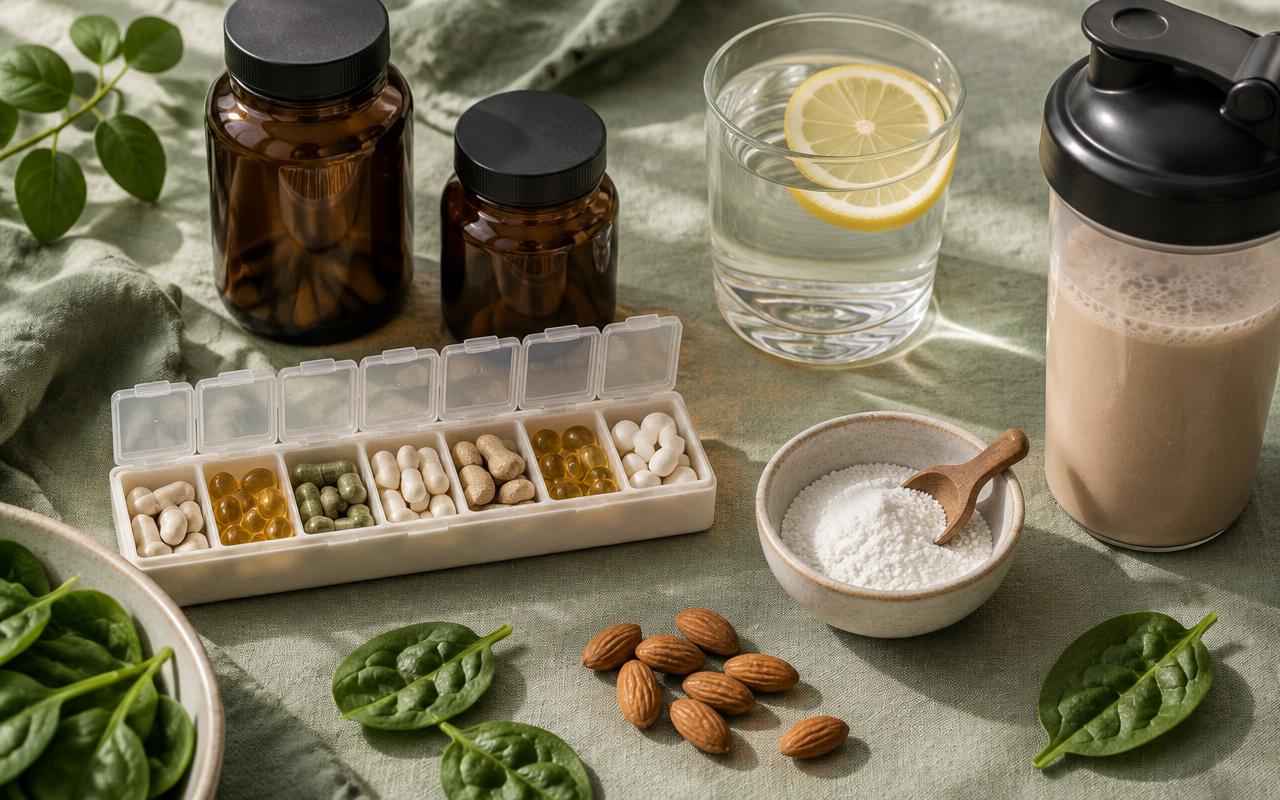
Short answer: the best vitamins to take while on a GLP-1 are vitamin B12, vitamin D3 with K2, iron (only if your labs are low), magnesium, calcium, and a full B-complex — ideally delivered by one complete multivitamin in absorbable forms rather than six separate bottles. None of them make semaglutide or tirzepatide work better. All of them replace what a much smaller appetite stops delivering.
This matters because GLP-1 medications do not cause deficiencies directly. They cut how much food you eat — usually 30–50% less within the first two dose steps — and vitamins ride in on food. Eat a third less, and you take in roughly a third less B12, D, iron, folate, and magnesium, week after week, while your body is simultaneously rebuilding tissue during rapid weight loss.
Below is the exact checklist: which vitamins matter most, the doses and chemical forms that absorb when food volume and stomach acid are low, when to take each one relative to your weekly injection, which ones to skip, and the labs worth asking your prescriber for.
The short list: 6 vitamins and minerals that matter on a GLP-1
One complete multivitamin built for GLP-1 users covers five of these six slots. Magnesium is worth taking separately, at night and at a higher dose than any multivitamin includes. Iron is the one item that should follow a blood test rather than a guess — the Elevate GLP range is designed around exactly this split, so you are not stacking six bottles on a stomach that already feels full.
- Vitamin B12 (methylcobalamin) — 500–1,000 mcg daily; the most commonly low nutrient on GLP-1s, and lower again if you take metformin
- Vitamin D3 with K2 — 1,000–2,000 IU daily (higher only if labs justify it); drives calcium absorption and bone protection during weight loss
- Iron (bisglycinate) — 18–27 mg only if ferritin or hemoglobin is low; never guess with iron
- Magnesium (glycinate) — 200–400 mg elemental at night for cramps, sleep, and regularity
- Calcium — 500–600 mg per dose if dairy and greens have left your plate; take separately from iron
- B-complex including folate and B6 — supports energy metabolism and hair regrowth when intake drops
1. Vitamin B12: the one to watch first
B12 comes almost entirely from animal foods — meat, fish, eggs, dairy — the dense, heavy foods most people on a GLP-1 stop finishing first. It is also the nutrient with the longest lag between low intake and obvious symptoms, because the liver stores a reserve that takes months to draw down. That is why fatigue and brain fog at month four often trace back to eating patterns from month one.
Take 500–1,000 mcg of methylcobalamin daily, or as part of a complete multivitamin. Methylcobalamin is the active form and does not depend on conversion; it also absorbs partly through the mouth's lining, which helps when digestion is slowed. If you also take metformin — common for anyone on Mounjaro or Ozempic for type 2 diabetes — ask for a B12 level, because metformin is independently associated with lower B12 over time.
And to settle the most common question: no GLP-1 pen contains B12. Compounded 'semaglutide with B12' or 'tirzepatide with B12' mixes sold by some telehealth clinics are a different, non-FDA-approved product. If you are on brand-name Ozempic, Wegovy, Mounjaro, or Zepbound, your B12 has to come from food or a supplement.
- Dose: 500–1,000 mcg methylcobalamin daily
- Timing: morning, with your first meal — B vitamins can be stimulating at night
- Watch for: fatigue, brain fog, tingling in hands or feet — get a blood test, not a guess
2. Vitamin D3 with K2: bone insurance during rapid weight loss
Rapid weight loss reduces the mechanical load on your skeleton, and studies of both semaglutide and tirzepatide show some loss of bone mineral density alongside fat and lean mass. Vitamin D is what allows the calcium you eat to actually be absorbed, so low D quietly undermines every other bone-protective thing you do. Deficiency is already common before anyone starts a GLP-1 — it becomes more likely once fortified dairy and fatty fish drop out of the rotation.
Take 1,000–2,000 IU of D3 daily with a meal that contains some fat, since D is fat-soluble and needs it to absorb. Higher doses belong to your prescriber and a blood level, not to guesswork. Vitamin K2 alongside it helps direct calcium into bone rather than soft tissue. If you take a blood thinner such as warfarin, do not add K2 without clearing it first.
3. Iron: only with a blood test
Iron is the exception to 'a multivitamin covers it.' Low iron is genuinely common on GLP-1s — red meat is often the first food to feel unappealing, and menstruating women start from a lower baseline — and it produces the exact same symptoms as B12 deficiency: exhaustion, breathlessness on stairs, hair shedding, cold hands.
But excess iron is stored, not excreted, and too much causes constipation, nausea, and over years real organ damage. So the rule is simple: test, then treat. Ask for ferritin plus a complete blood count. If you are low, iron bisglycinate at 18–27 mg is far gentler on a slowed gut than ferrous sulfate. Take it away from calcium, and with a source of vitamin C to improve uptake.
- Test first: ferritin and CBC — treat the number, not the symptom
- Form: iron bisglycinate, gentler on a GLP-1 gut than ferrous sulfate
- Separate from calcium by at least two hours; pair with vitamin C
4. Magnesium: the mineral GLP-1 users run out of fastest
Magnesium comes from nuts, legumes, whole grains, and leafy greens — a food group that shrinks fast on a GLP-1. Low intake shows up as night-time leg cramps, restless sleep, and a sluggish gut, which is why it is the most-felt gap on this list rather than the most-tested one.
Choose glycinate at 200–400 mg of elemental magnesium in the evening. Glycinate absorbs well and is gentle on slowed digestion, where oxide and citrate at higher doses push people toward diarrhea. The glycine itself supports sleep quality, which is why night-time dosing does double duty.
5. Calcium: only if dairy and greens have left your plate
Calcium is worth adding when your honest answer to 'how much dairy and leafy greens do you actually eat now?' is 'barely any.' Food first is still the better route, because calcium from food arrives in smaller, better-absorbed amounts throughout the day.
If you supplement, keep each dose at 500–600 mg — the body cannot absorb much more at once — take it with food, and keep it away from your iron. Calcium citrate absorbs better than carbonate when stomach acid is low, which is often the case on a GLP-1. Pair it with vitamin D and magnesium; alone, it does much less for bone than the trio does together.
6. B-complex, folate, and the hair-loss question
Hair shedding three to four months into a GLP-1 is one of the most searched side effects, and it is usually telogen effluvium — a stress response to rapid weight loss rather than a vitamin deficiency in itself. But low protein, low iron, low B12, low zinc, and low biotin all make it worse and last longer, and every one of those becomes more likely when you are eating a third less.
A full B-complex with folate and B6 inside a complete multivitamin covers this without megadosing. Resist standalone high-dose biotin: it does not reliably grow hair and it skews thyroid and troponin lab results, which can send you down an unnecessary diagnostic path. Protein at 1.2–1.6 g per kg of body weight matters far more for hair than any capsule.
Forms and doses that actually absorb on a GLP-1
The chemical form on the label matters more on a GLP-1 than it does for most people, because you are absorbing nutrients from less food, with slower gastric emptying and often less stomach acid. Cheap forms in a big-box multivitamin were designed for a full stomach.
- B12: methylcobalamin, not cyanocobalamin
- Folate: methylfolate, not folic acid
- Vitamin D: D3 (cholecalciferol) with K2, taken with fat
- Iron: bisglycinate, not ferrous sulfate
- Magnesium: glycinate, not oxide
- Zinc: picolinate or citrate, capped near 15–25 mg to protect copper balance
- Calcium: citrate rather than carbonate when acid is low
When to take your vitamins around shot day
The hardest window on a weekly GLP-1 is usually the 24–72 hours after your injection, and again for a few days after each dose increase. Capsules on an empty, nauseated stomach is how people end up abandoning a routine that was working. Build the week around the medication instead.
- Shot day: electrolytes and fluids first, liquid protein instead of a heavy meal, multivitamin only if food is staying down
- Days 1–2 after: keep protein liquid, second electrolyte serving, restart capsules with the first meal you tolerate
- Days 3–7: your best absorption window — take the multivitamin with breakfast and iron (if prescribed) with a citrus-containing lunch
- Every night: magnesium glycinate, with or without food
- Never: iron and calcium in the same dose — they compete for the same transport
Vitamins to skip while on a GLP-1
- 'GLP-1 booster,' 'GLP-1 activator,' and 'nature's Ozempic' capsules — nothing over the counter replicates a prescription GLP-1, and stacking them adds cost and risk without benefit
- Megadose biotin (5,000–10,000 mcg) — skews thyroid and cardiac lab results and does not reliably regrow hair
- High-dose vitamin A or E — fat-soluble, accumulate, and easy to overshoot when appetite is unpredictable
- Berberine, chromium, or gymnema without prescriber sign-off — all lower blood glucose, which raises hypoglycemia risk alongside a GLP-1 plus metformin or insulin
- Gummy multivitamins as your main source — usually short on iron and B12 and heavier on sugar than a shrinking calorie budget allows
- Iron 'just in case' — supplement only on the strength of a blood test
How Elevate GLP covers each gap
The Elevate GLP range was built for this specific problem: a small number of products that fill the nutrient slots a GLP-1 empties, in the forms that absorb when you are eating less.
The complete GLP-1 multivitamin handles B12, D3, the B-complex, and chelated minerals in one capsule taken at breakfast. Magnesium glycinate sits at night for cramps, sleep, and regularity. The electrolyte blend delivers sodium-forward hydration for the fatigue, headache, and dizziness cluster that vitamins alone never fix. Protein and gentle fiber round out the routine — because on a GLP-1, protein intake and a moving gut do more for how you feel day to day than any single vitamin does.
Iron stays deliberately outside the core stack. That one belongs to your labs and your prescriber.
Labs worth asking your prescriber for
A sensible rhythm is baseline labs before or early in treatment, then a recheck at three to six months — around the time nutrient reserves built on your old eating pattern start running out. If you have kidney disease, heart failure, or take a diuretic or blood thinner, confirm your mineral targets with your prescriber before adding anything.
- Vitamin B12 (with homocysteine or methylmalonic acid if borderline)
- Ferritin plus a complete blood count — the real iron picture
- 25-hydroxy vitamin D
- A basic metabolic panel, for sodium, potassium, and kidney function
- Thyroid panel if fatigue and hair shedding persist despite a solid routine
FAQ: vitamins on a GLP-1
What are the best vitamins to take while on a GLP-1? B12, vitamin D3 with K2, magnesium, a full B-complex, calcium if dairy and greens are gone, and iron only if labs are low. One complete multivitamin plus separate magnesium covers nearly all of it.
Do I need vitamins on Ozempic, Wegovy, Mounjaro, or Zepbound? The list is the same for all four. Semaglutide and tirzepatide differ in how strongly they suppress appetite, not in which nutrients food stops delivering — so a stronger appetite effect simply means the gaps open faster.
Does Ozempic or Mounjaro contain B12? No. Both are single peptides with no vitamins in the pen. Compounded 'GLP-1 with B12' mixes from some clinics are a separate, non-FDA-approved product.
When is the best time to take vitamins on a GLP-1? The multivitamin with your first real meal, iron with a vitamin-C-containing meal away from calcium, and magnesium at night. On shot day, lead with fluids and take capsules only once food is staying down.
Can vitamins cause nausea on a GLP-1? Yes — iron, zinc, and large multivitamin tablets on an empty stomach are the usual culprits. Take them mid-meal, split doses, or switch to a capsule format.
Will vitamins stop hair loss on a GLP-1? They remove the nutritional obstacles, but the shedding itself is mostly driven by rapid weight loss. Adequate protein, correcting low iron and B12, and time are what resolve it — usually within three to six months of weight stabilizing.
Do I still need vitamins after I stop the medication? Once appetite returns and you are eating a full, varied diet, food covers most of it. Keep supplementing anything your labs still show as low, and keep vitamin D if you live somewhere with limited winter sun.
Related guides
Medication guides mentioned in this article
Related tools
Supplements built for your GLP-1 journey
Formulated for the exact nutrient gaps GLP-1 medications create — protein, electrolytes, magnesium, digestive support, and more. Trusted by thousands staying strong, energetic, and healthy on Ozempic, Wegovy, Mounjaro, and Zepbound.
Continue reading
GLP-1 Vitamins: The Daily Supplements Worth Taking (and Why)
Supplements to Take With Zepbound: The Complete 2026 List

The Best GLP-1 Supplement Stack: What to Take Daily (2026 Guide)

How Much Protein Should You Eat on a GLP-1? (2026 Daily Targets)