The Best Fiber Supplement for GLP-1 Users (and When to Take It)
GLP-1 medications slow digestion and cut food intake, which quietly drops most users to under half the fiber they need — the #1 driver of constipation, bloating, and sluggish energy on Ozempic, Wegovy, Mounjaro, and Zepbound. Here's how much fiber you actually need, which type works best (and which makes things worse), exact timing around your injection, and how to add it without nausea.
Fiber is the single most under-eaten nutrient on GLP-1 therapy — and the one most directly responsible for the complaints people post about daily: constipation, bloating, hard stools, sulfur burps, and that heavy, sluggish feeling two days after an injection.
The math is simple. Adults need 25–35 g of fiber a day. Most Americans already fall short at roughly 15 g. Cut total food intake by 30–40% (exactly what Ozempic, Wegovy, Mounjaro, and Zepbound do), and daily fiber can quietly drop to 8–12 g. Meanwhile the medication itself slows gastric emptying and colonic transit, so you have less fiber moving through a slower system. That combination is why constipation shows up in roughly 1 in 4 GLP-1 users in clinical trials.
A fiber supplement fixes that gap in about 30 seconds a day — but only if you pick the right type, dose it up gradually, take it at the right time relative to your shot, and pair it with enough water. Get any one of those wrong and fiber makes bloating worse instead of better. Below is the exact protocol.
The short answer
- Best type for GLP-1 users: soluble, gel-forming fiber — psyllium husk is the most evidence-backed, followed by partially hydrolyzed guar gum (PHGG) and acacia fiber for people who bloat easily.
- Target dose: 25–35 g total fiber daily (food + supplement). Most GLP-1 users need 8–15 g from a supplement to close the gap.
- Start low: 3–5 g per day for the first week, then increase by 3–5 g weekly. Jumping straight to 15 g causes gas and cramping.
- Water is non-negotiable: at least 8–12 oz per serving, plus 80–100 oz total daily. Fiber without fluid worsens constipation.
- Best timing: morning or early afternoon, 2+ hours away from other supplements and medications. Avoid the 24–48 hours right after your injection if nausea peaks then.
- Avoid as a first choice: bulk-only insoluble fiber (raw wheat bran) and inulin/chicory root — both commonly increase bloating on a slowed-down GLP-1 gut.
Why GLP-1 medications create a fiber gap
GLP-1 receptor agonists work partly by slowing gastric emptying — food leaves your stomach more slowly, so you feel full longer on less. That mechanism is why they work, and also why fiber intake collapses.
- Smaller portions: eating 30–40% less food means eating 30–40% less fiber, automatically.
- Protein crowds out plants: most GLP-1 users (correctly) prioritize protein to protect muscle, which leaves little appetite room for beans, vegetables, and whole grains.
- Slower transit: reduced gut motility means stool spends longer in the colon, where more water is reabsorbed — producing harder, drier stools.
- Less fluid intake: appetite suppression blunts thirst cues too, and dehydration compounds constipation.
- Fewer fermentable carbs: less fiber means less fuel for the gut bacteria that produce short-chain fatty acids like butyrate, which keep the colon lining healthy and motility normal.
How much fiber do you need on a GLP-1?
- General target: 25 g/day for women, 30–38 g/day for men (Institute of Medicine).
- Practical GLP-1 target: 25–30 g/day total, with at least 8–10 g of that soluble.
- Typical GLP-1 intake without a supplement: 8–14 g/day — a 15–20 g shortfall.
- Realistic split: 12–18 g from food (berries, avocado, chia, beans, oats, vegetables) + 8–15 g from a supplement.
- Don't exceed ~40 g/day: more isn't better, and very high intakes can reduce mineral absorption and increase gas.
Soluble vs. insoluble fiber: which one GLP-1 users need
This distinction matters more on a GLP-1 than it does for the general population, because your gut is already moving slowly.
- Soluble fiber dissolves in water and forms a gel. It softens stool, normalizes both constipation and diarrhea, feeds gut bacteria, and blunts blood-sugar swings. This is the priority on a GLP-1.
- Insoluble fiber adds bulk without holding water. It speeds transit in a healthy gut, but on a slowed GLP-1 gut, adding bulk without moisture can make stools harder and increase cramping.
- Best of both worlds: psyllium husk is roughly 70% soluble and 30% insoluble — it forms a gel while adding gentle bulk, which is why it consistently outperforms other fibers in constipation trials.
- Rule of thumb: prioritize soluble/gel-forming fiber, get insoluble fiber from whole food vegetables rather than a bran supplement.
The best fiber supplement types, ranked for GLP-1 users
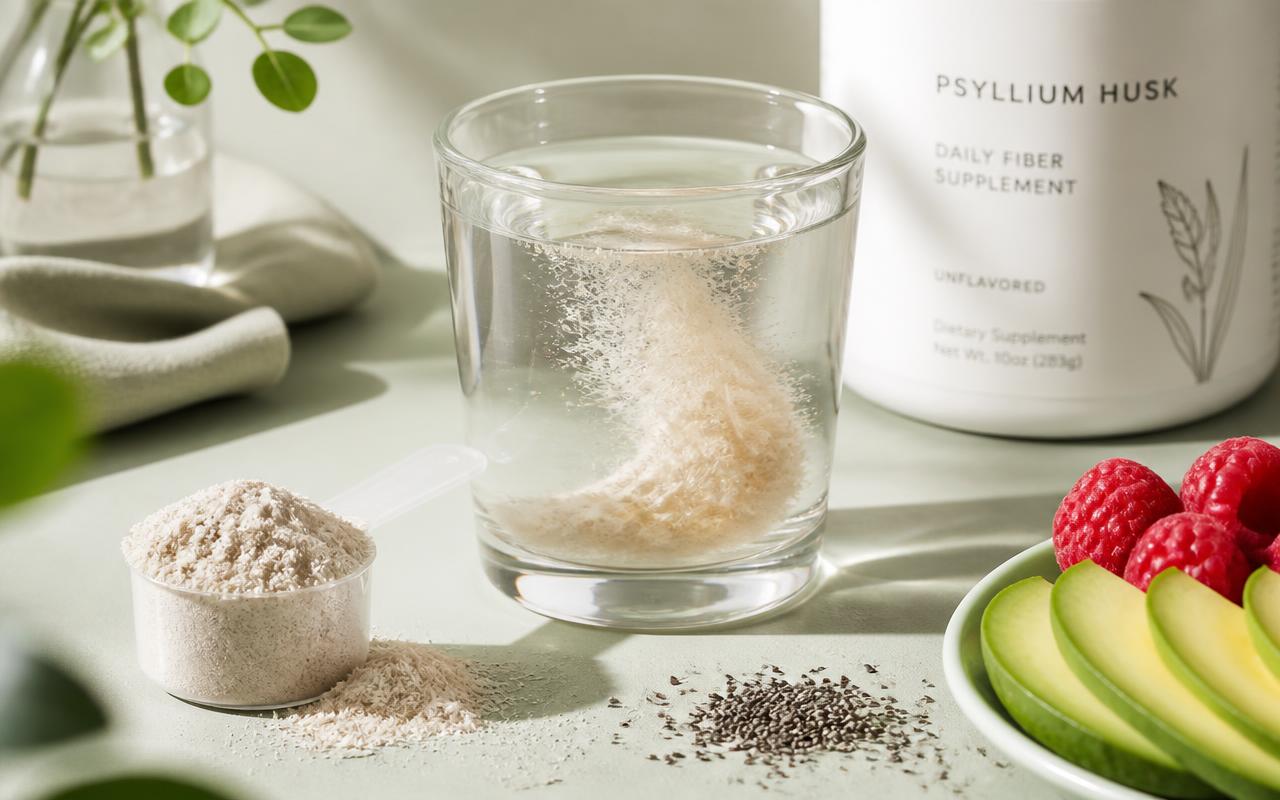
- 1. Psyllium husk (5–10 g/day): the most studied fiber for constipation. Forms a soft gel, improves stool frequency and consistency, lowers LDL cholesterol, and steadies post-meal glucose. Start at 3–5 g. Needs plenty of water. Best all-around pick.
- 2. Partially hydrolyzed guar gum / PHGG (5–7 g/day): low-viscosity, essentially tasteless, dissolves clear in water, and is well tolerated by people with IBS or heavy bloating. Best choice if psyllium feels too thick or gassy.
- 3. Acacia (gum arabic) fiber (5–10 g/day): very gentle prebiotic, ferments slowly so it produces less gas than inulin. Good for sensitive guts.
- 4. Magnesium glycinate + fiber combo: magnesium isn't fiber, but 200–400 mg at night draws water into the bowel and pairs with fiber to resolve GLP-1 constipation faster than either alone.
- 5. Methylcellulose (2–6 g/day): non-fermentable, so almost no gas — but it doesn't feed gut bacteria. A reasonable option if everything else bloats you.
- Use with caution: inulin / chicory root fiber. It's an excellent prebiotic in theory, but it ferments fast and is one of the most common causes of severe bloating and gas in GLP-1 users. Skip it while your gut is adjusting.
- Avoid as a primary supplement: raw wheat bran. Purely insoluble, harsh on a slow gut, and frequently worsens cramping.
When to take fiber on a GLP-1: exact timing
Fiber timing matters more on a GLP-1 than off it, because gastric emptying is delayed and fiber can bind other nutrients and medications.
- Best window: morning with breakfast, or early afternoon. This gives it a full active day to move through your system.
- Second best: mid-afternoon (around 2–3 PM), especially if mornings are your most nauseated hours.
- Avoid right before bed with a large dose — a gel-forming fiber sitting in a slow stomach overnight can cause reflux and morning bloat. Magnesium is the better nighttime option.
- Space from medications: take fiber at least 2 hours after or 4 hours before oral medications (thyroid meds, some antibiotics, oral contraceptives) and iron or zinc supplements, since fiber can reduce absorption.
- Around your injection: if days 1–2 post-shot are your worst nausea days, keep fiber at the low end of your dose then, and return to your full dose on days 3–7 when appetite and tolerance improve.
- Split large doses: 5 g in the morning + 5 g in the afternoon is far better tolerated than 10 g at once.
- Always with 8–12 oz of water, and finish another glass within 30 minutes.
A 4-week ramp-up schedule that avoids bloating
- Week 1: 3 g once daily in the morning, with 12 oz water. Expect a mild adjustment period.
- Week 2: 5 g once daily. Add magnesium glycinate 200 mg at night if stools are still hard.
- Week 3: 5 g morning + 3 g afternoon (8 g total).
- Week 4: 5 g morning + 5 g afternoon (10 g total) — pair with 12–18 g from food for a 25–30 g daily total.
- If you bloat at any step: hold at the previous dose for another week, increase water, and switch from psyllium to PHGG or acacia.
- If nothing changes after 2 weeks at 10 g: your problem is likely hydration or motility, not fiber. Raise water to 90–100 oz, add electrolytes, add magnesium at night, and walk 10–15 minutes after meals.
Whole-food fiber sources that work on a small appetite
Supplements close the gap, but food fiber brings polyphenols, micronutrients, and a broader mix of fermentable substrates. These are the highest fiber-per-bite options for a suppressed appetite.
- Chia seeds: 10 g fiber per oz — stir 1 tbsp into yogurt or a protein shake.
- Ground flaxseed: 8 g per 2 tbsp, plus omega-3s.
- Avocado: 10 g per medium fruit, and easy to tolerate.
- Raspberries: 8 g per cup — highest-fiber common fruit.
- Black beans / lentils: 7–8 g per half cup, plus 7–9 g protein.
- Rolled oats: 4 g per half cup dry, with beta-glucan for cholesterol and glucose control.
- Broccoli, Brussels sprouts, artichoke: 4–7 g per cooked cup.
- Note: high-FODMAP options like beans and Brussels sprouts can add gas on a slowed gut — introduce them one at a time.
Signs you need more fiber (and signs you took too much)
- Need more: fewer than 3 bowel movements per week, hard or pellet-like stools, straining, feeling incompletely emptied, or persistent low-grade bloating.
- Need more: post-meal glucose swings and energy crashes despite eating protein.
- Too much, too fast: sharp increase in gas, cramping, audible gurgling, or a distended belly within days of increasing.
- Too much without water: stools got harder, not softer — the classic sign of fiber taken with insufficient fluid.
- Stop and call your prescriber: severe abdominal pain, vomiting, no bowel movement for 4+ days, or a firm distended abdomen — these can signal an obstruction, which needs evaluation rather than more fiber.
How fiber fits into the Elevate GLP stack
Fiber is one piece of the GLP-1 nutrient gap, not the whole picture. Our formulas are built around the specific shortfalls these medications create — so each piece solves a different problem and they work better together than alone.
- Gut Health support: gentle, gel-forming soluble fiber plus digestive support to restore regularity without the bloat of fast-fermenting fibers.
- Magnesium Glycinate: 200–400 mg at night draws water into the bowel, relaxes smooth muscle, and improves sleep — the single best partner to fiber for GLP-1 constipation.
- Electrolytes: sodium, potassium, and magnesium keep you hydrated enough for fiber to work at all, and cut the headaches and dizziness of the first weeks.
- Protein support: 1.2–1.6 g/kg body weight daily protects lean mass while appetite is suppressed — the other half of eating well on less food.
- Daily multivitamin coverage: B12, vitamin D, iron, and folate gaps are common by month 3–6 on reduced intake.
Frequently asked questions
- What is the best fiber supplement for GLP-1 users? Psyllium husk, 5–10 g daily, split into two doses with plenty of water. If psyllium causes bloating, switch to partially hydrolyzed guar gum (PHGG) or acacia fiber.
- Can I take fiber and Ozempic together? Yes. There's no interaction with injectable semaglutide. Just space fiber 2+ hours from oral medications and iron or zinc supplements.
- Will fiber make my GLP-1 bloating worse? It can if you start too high, skip water, or choose inulin/chicory root. Start at 3 g, increase weekly, and drink 8–12 oz per serving.
- How long until fiber fixes GLP-1 constipation? Most people see improvement in 2–5 days at an adequate dose with enough water and magnesium. If nothing changes in 2 weeks, hydration or motility is the bottleneck.
- Should I take fiber in the morning or at night? Morning or early afternoon. Save magnesium glycinate for bedtime.
- Does fiber reduce the effectiveness of my GLP-1 medication? No. Injectable GLP-1s bypass the digestive tract entirely. Fiber can slightly slow absorption of oral medications, which is why you space them out.
- Can fiber help with GLP-1 nausea? Indirectly. Relieving constipation and backed-up transit often reduces nausea, sulfur burps, and early fullness. But large fiber doses on an already-full stomach can worsen nausea — keep doses small and split.
- Do I still need fiber if I'm eating lots of vegetables? Probably yes. Most GLP-1 users eating what feels like plenty of vegetables still land at 12–18 g/day because portions are so much smaller.
- Is chia seed as good as a psyllium supplement? Chia is excellent food fiber (10 g/oz) but harder to dose precisely and less studied for constipation specifically. Use both.
Related guides
Medication guides mentioned in this article
Related tools
Supplements built for your GLP-1 journey
Formulated for the exact nutrient gaps GLP-1 medications create — protein, electrolytes, magnesium, digestive support, and more. Trusted by thousands staying strong, energetic, and healthy on Ozempic, Wegovy, Mounjaro, and Zepbound.