
GLP-1 Muscle Loss: The Supplements That Actually Help (2026)
Why weight lost on Ozempic, Wegovy, Mounjaro and Zepbound can include muscle — and the supplements with real evidence for protecting it: protein, creatine, vitamin D, electrolytes, and the training you can't skip.
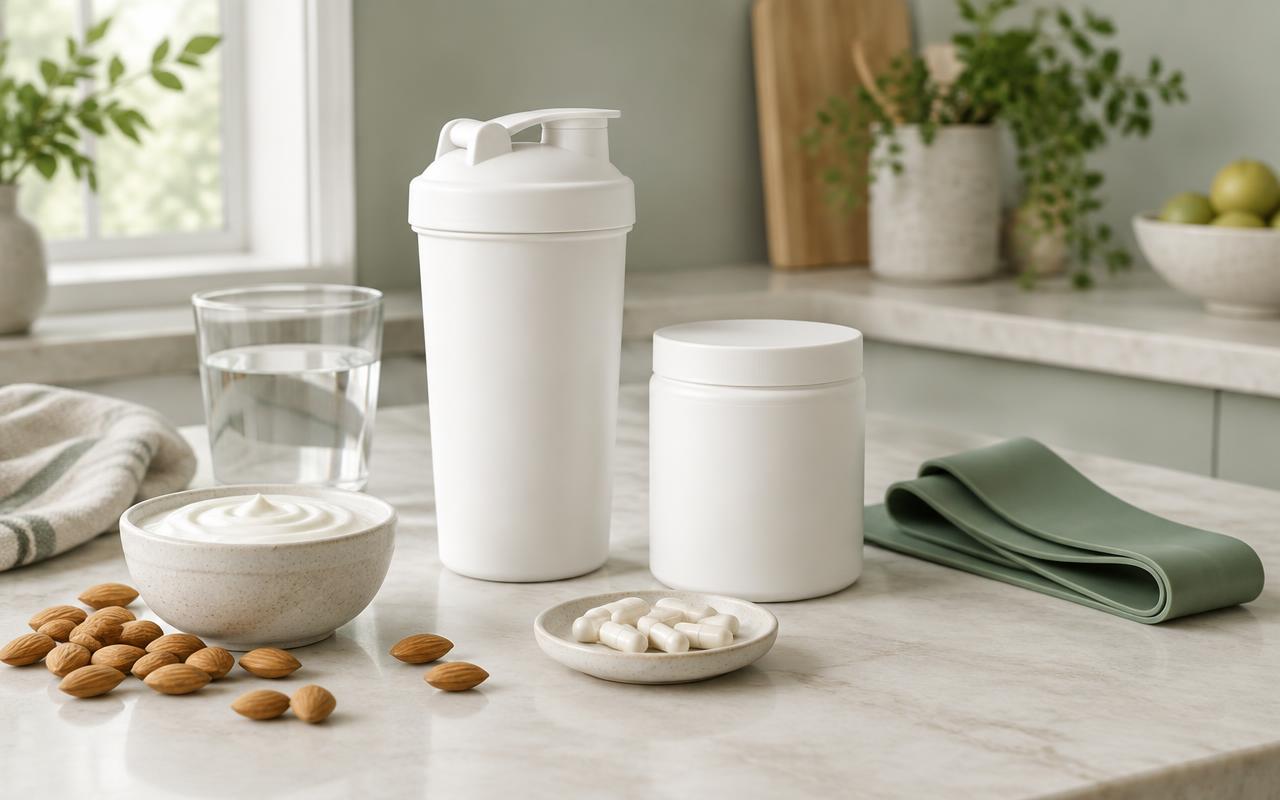
Short answer: some lean-mass loss during any significant weight loss is expected, and GLP-1 medications are no exception — clinical trial body-composition analyses suggest roughly a quarter to two-fifths of the weight lost can be lean tissue rather than fat. The supplements with meaningful evidence for protecting that tissue are a short list: enough protein, creatine monohydrate, vitamin D where you're low, and electrolytes so you can actually train. No capsule builds or keeps muscle on its own — resistance training does the heavy lifting, and supplements support it.
This article covers why muscle loss happens on semaglutide and tirzepatide, how much is normal, which supplements have real evidence behind them (and which don't), how to time protein around a small appetite, and where the Elevate GLP range fits if you'd rather buy a routine built for exactly this problem.
One important framing before the details: losing some lean mass while losing a lot of fat is not automatically a health problem — what matters is the proportion, your strength, and how you feel. The goal of everything below is to shift that ratio toward fat and keep you strong, not to promise that the scale will only ever move in one tissue.
Why GLP-1 weight loss can include muscle
GLP-1 and dual GIP/GLP-1 medications reduce appetite and slow stomach emptying, so you eat less. When total energy intake falls quickly, the body draws on both fat stores and lean tissue for fuel — that's true of every weight-loss method, not just injections. What changes the picture on GLP-1s is speed and appetite suppression: weight often comes off faster than with diet alone, and protein is usually the first thing people under-eat because rich, meaty meals lose their appeal first.
Body-composition substudies of the major semaglutide and tirzepatide trials using DEXA scans have generally found that lean mass accounts for somewhere around 25–40% of total weight lost. That sounds alarming until you compare it with bariatric surgery or aggressive dieting, which show similar proportions. Still, muscle is metabolically active tissue — it supports blood-sugar control, bone health, balance and the strength to stay independent — so defending it is worth deliberate effort.
- Rapid weight loss of any kind typically includes 20–40% lean tissue without countermeasures
- Lower appetite means protein intake often falls before anything else
- Fatigue and lightheadedness from low fluid and electrolytes can quietly cut training quality
- Older adults, post-menopausal women, and people losing weight very fast have the most to protect
How much muscle loss is normal — and when to act
A reasonable expectation: if you're losing weight steadily and not training, a meaningful share of it will be lean mass. The warning signs aren't subtle once you look for them — clothes fitting differently but lifts or stairs feeling harder, grip strength slipping, or feeling weaker week over week. The countermeasures that move the needle are boring and well-established: eat enough protein, train against resistance two to three times a week, sleep enough, and don't crash-diet on top of the medication.
If you're losing strength rapidly, feel faint during normal activity, or are an older adult losing weight quickly, raise it with your prescriber — dose titration speed and total intake are clinical decisions, and a dietitian referral is often the highest-value step available.
Protein: the one supplement with the strongest case
If you only fix one thing, fix protein. Research on preserving lean mass during weight loss consistently points to higher protein intakes — commonly in the range of 1.2–1.6 g per kilogram of body weight per day, sometimes more for people training hard — combined with resistance exercise. On a GLP-1 that can be a genuinely hard target to hit from food alone, because appetite is smallest exactly when protein needs are highest.
This is where a protein supplement earns its place: not because powder is magic, but because 20–30 g of protein in a drinkable, easy-to-tolerate format solves the practical problem. Whey is the best-studied option; collagen peptides add glycine and proline that support connective tissue and skin but are lower in leucine, so they complement rather than replace a complete protein. The Elevate GLP protein and collagen support products are built around this exact gap — drinkable, portion-controlled protein that doesn't ask you to finish a large meal.
- Aim to anchor each meal with protein first, before carbs or fats
- Distribute intake across the day rather than one large serving — 20–40 g per eating occasion is a practical target
- A shake between meals counts; consistency beats perfection
- If nausea makes shakes hard, try smaller volumes, cooler temperatures, and sipping over 20–30 minutes
Creatine monohydrate: cheap, studied, and underused
Creatine is one of the most researched supplements in existence, with decades of safety data in healthy adults. Its role during weight loss is specific: it helps maintain training performance and supports lean-mass retention when combined with resistance training. Standard dosing is 3–5 g of creatine monohydrate daily — no loading phase needed, no cycling, no exotic forms with better marketing.
Two cautions that matter on a GLP-1: creatine pulls water into muscle cells, so hydration and electrolytes matter more, not less; and the first week or two can add a kilogram or so of water weight, which can mask fat loss on the scale. Neither is a reason to avoid it — they're reasons to drink enough and to track strength and waist measurements alongside weight.
Vitamin D, calcium and the bone connection
Muscle and bone are lost together more often than separately. Rapid weight loss is associated with reductions in bone mineral density, and vitamin D plus calcium are the foundational pair for bone health — vitamin D also plays a role in muscle function, and deficiency is common. Supplementing makes the clearest sense when intake is low or a blood test shows insufficiency, which is worth asking for at your next check-up: vitamin D (25-OH), B12, ferritin and a basic metabolic panel cover the usual suspects on a GLP-1.
A well-formulated multivitamin covers everyday gaps created by a smaller plate, but it doesn't replace targeted doses where a lab result shows a real deficiency — that's a conversation for your prescriber, not a guessing game.
Electrolytes: the quiet enabler of training
Nothing on this list works if you feel too washed out to train. Lower food intake means less sodium, potassium and fluid coming in, and the classic GLP-1 symptoms — headaches, lightheadedness on standing, flat workouts — are frequently hydration and electrolyte problems in disguise. A sugar-free electrolyte with a meaningful sodium content (hundreds of milligrams, not a trace) is often the single fastest quality-of-life improvement people report.
The Elevate GLP electrolyte formula was designed for exactly this: real sodium and potassium doses, no sugar, no artificial dyes — the kind of product you can take daily without it becoming a dessert.
What about HMB, BCAAs, and 'muscle protection' blends?
HMB (beta-hydroxy beta-methylbutyrate) has some evidence in older and clinical populations for reducing muscle breakdown, but the effect sizes are modest and protein adequacy comes first. BCAAs are largely redundant if total protein intake is where it should be — you get them from protein itself. Proprietary 'muscle protection' or 'GLP-1 support' blends that hide doses behind a single number deserve the same scepticism as any other hidden blend.
Be equally wary of anything marketed as a 'GLP-1 booster' or implying it enhances the medication itself — the NIH has cautioned that these claims run far ahead of the evidence, and no supplement increases semaglutide's or tirzepatide's effect.
The part no supplement can do: resistance training
Every study that shows lean-mass preservation during weight loss pairs protein with resistance training. Without a training stimulus, extra protein blunts losses but doesn't stop them. The good news is the effective dose of training is smaller than most people think: two to three full-body sessions per week covering the basic movement patterns — squat or leg press, hinge, push, pull, carry — with weights that feel challenging by the last few reps.
On low-energy days, shorten the session rather than skipping it. Ten hard sets beat zero. Walking daily preserves the habit on rest days, supports digestion, and costs almost no recovery.
- Two to three resistance sessions per week, full body, progressive
- Prioritise the big patterns over machines and isolation work
- Keep a simple log — strength trend is your best muscle-loss alarm
- Walking 7–10k steps supports weight maintenance without taxing recovery
A simple daily routine that covers the bases
That is the entire list. It fits in one small basket, takes under two minutes a day, and every item has a defined job. If you want it pre-assembled, the Elevate GLP range covers each slot — protein and collagen support, electrolytes, a multivitamin, and magnesium glycinate — with third-party purity and potency testing and no unnecessary fillers, artificial dyes or hidden sweeteners. Compare labels and cost per dose with anything else you're considering; that comparison is the point of this article.
- Morning: electrolytes in a large glass of water, especially on injection day and the day after
- Each meal: protein first; add a shake on days food falls short
- Any time of day: creatine monohydrate 3–5 g, with any drink
- With food: multivitamin to cover the smaller plate
- Evening: magnesium glycinate if sleep, cramps or recovery have slipped
- Weekly: two to three resistance sessions, logged
Who should talk to their clinician first
- Anyone with kidney disease or reduced kidney function — protein and creatine dosing need individual guidance
- People with a history of eating disorders, where rigid tracking can be counterproductive
- Older adults or anyone losing strength unusually fast — ask about dose pace and a dietitian referral
- Anyone pregnant, breastfeeding, or managing diabetes medications alongside a GLP-1
- People whose blood tests show deficiencies — targeted treatment beats blanket supplementation
FAQ: muscle loss on GLP-1 medications
Is muscle loss on Ozempic inevitable? No — the proportion depends heavily on protein intake and resistance training. Some lean-mass loss during major weight loss is normal; losing a large share of it is largely preventable.
Does muscle loss slow my metabolism permanently? Severe lean-mass loss can lower resting energy expenditure, which is one more reason to defend it. Keeping protein high and training while you lose is the established countermeasure.
Can supplements replace strength training? No. Protein and creatine support the adaptation that training triggers; they don't trigger it themselves.
Will creatine make me gain weight on a GLP-1? It can add a kilogram or so of water inside muscle cells in the first weeks. That's not fat, and it usually helps training quality — track strength and measurements, not just the scale.
How do I know if I'm losing muscle? Strength trends are the best free test. If you want data, ask about a DEXA scan or use consistent tape measurements; smart scales are too imprecise to trust week to week.
Related guides
Medication guides mentioned in this article
Related tools
Supplements built for your GLP-1 journey
Formulated for the exact nutrient gaps GLP-1 medications create — protein, electrolytes, magnesium, digestive support, and more. Trusted by thousands staying strong, energetic, and healthy on Ozempic, Wegovy, Mounjaro, and Zepbound.
Continue reading
The Best GLP-1 Supplement Stack: What to Take Daily (2026 Guide)
Best Over-the-Counter GLP-1 Supplements (2026): What Actually Helps
Supplements for GLP-1 Users: The 2026 Buyer’s Guide
Does Zepbound Cause Constipation? Why It Happens + 9 Proven Fixes

A Day in the Life on a GLP-1: The Simple Routine That Keeps You Healthy (2026)
Ready to build your routine?
Protein, collagen, electrolytes, magnesium and everyday vitamins formulated for GLP-1 users — third-party tested, no unnecessary fillers, and 10% off when you subscribe (pause or cancel any time).
Try Elevate GLP supplements