Does Ozempic Cause Diarrhea? Why It Happens & How to Stop It Fast
Yes — diarrhea is one of the most common side effects of Ozempic, affecting up to 30% of users, especially in the first weeks and after dose increases. Here's exactly why it happens, how long it lasts, and the evidence-based way to stop it fast without quitting your GLP-1.
If you've started Ozempic (semaglutide) — or just moved up to a higher dose — and you're suddenly running to the bathroom, you're not alone. Diarrhea is one of the top three most reported side effects of GLP-1 medications, right alongside nausea and constipation. The good news: it's almost always temporary, manageable at home, and does not mean you have to stop the drug.
In the STEP clinical trials for semaglutide, roughly 30% of people on the 2.4 mg dose reported diarrhea vs. about 15% on placebo. The pattern is remarkably predictable — it tends to appear in the first 4 to 8 weeks and flares again for a few days after each dose escalation. This guide walks through exactly why it happens, how long it lasts, when to worry, and the specific steps (food, hydration, electrolytes, supplements) that stop it fastest.
The short answer: yes, and here's how common it is
Diarrhea on Ozempic is well-documented and expected. It's not a sign the drug is 'not working' or that something is wrong — it's a direct consequence of how GLP-1 receptor agonists change your digestion.
- ~20–30% of people on semaglutide (Ozempic/Wegovy) report diarrhea at some point
- Most common in weeks 1–8 and for 2–5 days after each dose increase
- Usually mild to moderate — 2–4 loose stools per day, not the severe, dehydrating kind
- Typically resolves on its own within 2–4 weeks as your gut adapts
- Same pattern for Wegovy, Mounjaro (tirzepatide), and Zepbound
Why Ozempic causes diarrhea: the real mechanism
Ozempic slows down how fast food leaves your stomach (delayed gastric emptying) — that's how it makes you feel full for longer. But it also affects the rest of your gut, and that's where diarrhea comes in. Three things are happening at once:
- Altered gut motility: GLP-1 receptors are dense in your intestines. When they're activated, motility patterns shift — sometimes toward slowing (constipation), sometimes toward speeding up (diarrhea). Which one you get depends on your baseline gut, diet, and dose.
- Bile-acid changes: slower stomach emptying means bile pools and then dumps into the small intestine in larger boluses, which can irritate the colon and pull water into the stool.
- Microbiome shift: eating dramatically less food (and often less fiber) rapidly changes gut bacteria composition in the first weeks, which loosens stool until your microbiome rebalances.
- Fatty or high-sugar meals: with delayed emptying, rich or greasy foods sit longer and often trigger a 'dumping' reaction 2–6 hours later.
How long does Ozempic diarrhea last?
For the vast majority of people, Ozempic-related diarrhea is short-lived and follows a predictable curve tied to your dose schedule.
- Week 1–2 after starting: often the worst — 3–5 loose stools per day is common
- Week 3–4: episodes drop to a few times per week as your gut adapts
- Week 6–8: most people are back to a normal baseline
- After each dose bump (0.25 → 0.5 → 1.0 → 2.0 mg): expect 2–5 days of loose stools, then it settles
- Persistent daily diarrhea beyond 8 weeks is not typical — that warrants a call to your prescriber
How to stop Ozempic diarrhea fast: 9 evidence-based steps
You can't always prevent it during the first two weeks or after a dose increase, but you can shorten each episode dramatically and keep it from disrupting your day. These are the highest-leverage moves, ordered by impact.
1. Replace electrolytes before you're dehydrated
This is the single most important step. Diarrhea flushes sodium, potassium, and magnesium — and on Ozempic, you're already eating less food, so you're getting fewer electrolytes to start with. Depletion is what causes the fatigue, headaches, dizziness, and muscle cramps that make GLP-1 diarrhea feel awful.
Aim for 2,000–3,000 mg sodium, 1,000–1,500 mg potassium, and 300–400 mg magnesium per day during a diarrhea flare. A no-sugar electrolyte packet (LMNT, Liquid IV Sugar-Free, Nuun, or a similar sodium-forward mix) twice a day covers most of it. Plain water alone will actually make electrolyte loss worse.
2. Eat BRAT-style for 24–48 hours
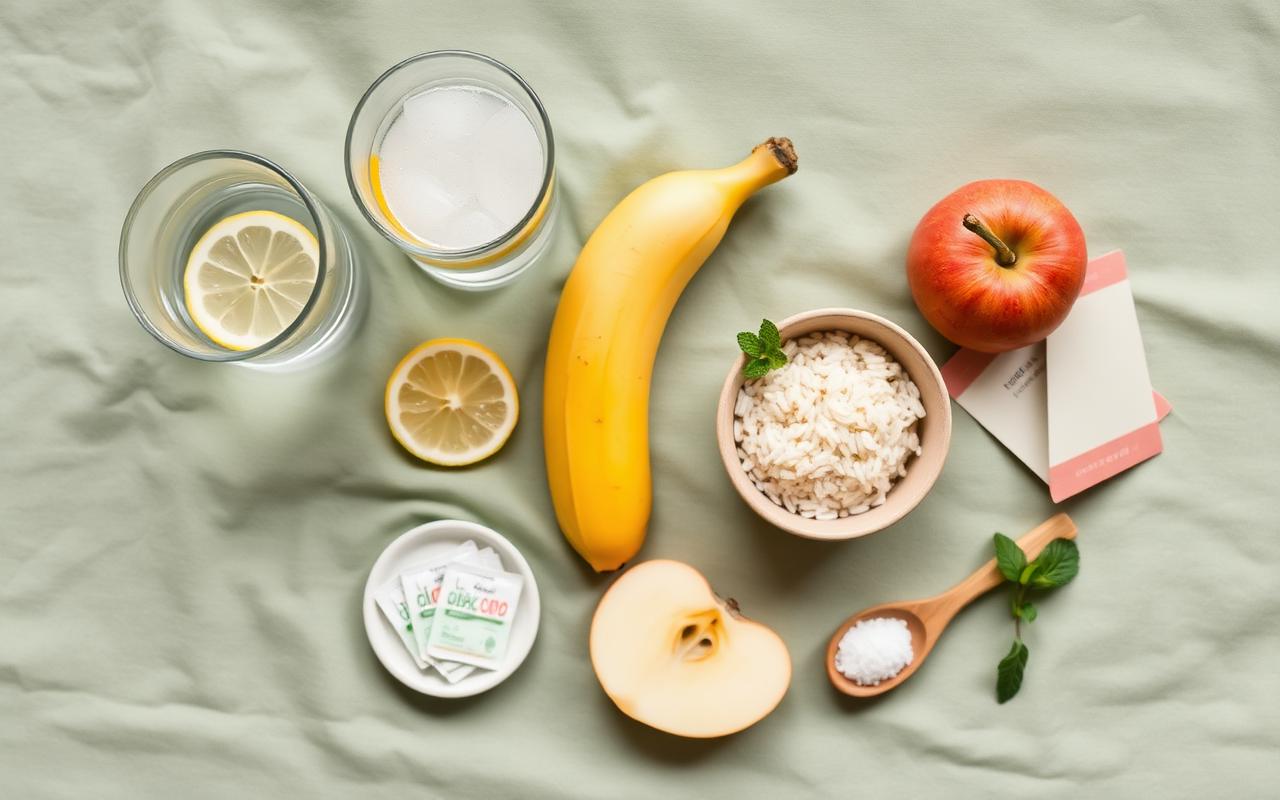
The classic BRAT diet — bananas, rice, applesauce, toast — is bland, low-fat, and low-fiber, which is exactly what an irritated gut needs. Add plain chicken, eggs, oatmeal, and boiled potatoes. Bananas in particular are gold: they replace potassium and contain pectin, a soluble fiber that firms up stool.
- Yes: white rice, bananas, applesauce, plain toast, oatmeal, boiled potatoes, plain chicken, eggs
- No (temporarily): fried food, cheese, cream, ice cream, raw salads, beans, cabbage, coffee, alcohol, sugar alcohols (sorbitol, xylitol, erythritol)
- Skip artificial sweeteners entirely — sugar alcohols cause diarrhea even in people not on Ozempic
3. Add soluble fiber (psyllium or acacia) — not insoluble
This surprises people: fiber can actually stop diarrhea, if it's the right kind. Soluble fiber like psyllium husk or acacia fiber absorbs water in the intestine, forming a gel that firms up loose stool. Insoluble fiber (raw vegetables, wheat bran, seeds) does the opposite and makes things worse during a flare.
Start with 3–5 g of psyllium husk in 8 oz of water once daily, and take it 1–2 hours away from any oral medications. Increase to twice daily if needed.
4. Cut fat and rich foods for 3–4 days
Fat is the single biggest trigger for GLP-1 dumping episodes. Because your stomach empties slowly, a fatty meal sits, then releases in a burst that overwhelms the small intestine and triggers rapid transit. Keep meals under 15 g of fat per sitting during a flare — grilled chicken, baked fish, egg whites, plain Greek yogurt, and rice-based bowls are safe territory.
5. Time and shrink your meals
Four to five small meals of 300–400 calories are much easier on a GLP-1 gut than two big ones. Large meals distend a slow-emptying stomach and trigger reflexive urgency downstream. Stop eating 3 hours before bed — lying down with undigested food is a reliable way to wake up needing the bathroom.
6. Add a daily probiotic
A multi-strain probiotic (10–50 billion CFU with Lactobacillus and Bifidobacterium strains, and ideally Saccharomyces boulardii) can meaningfully shorten diarrhea episodes and help your microbiome adapt to your new eating pattern. Take it in the morning, away from hot drinks. S. boulardii in particular has strong evidence for reducing antibiotic- and medication-associated diarrhea.
7. Consider loperamide (Imodium) for short-term relief — carefully
OTC loperamide is safe and effective for occasional Ozempic-related diarrhea. Take 2 mg after the first loose stool, then 2 mg after each subsequent one, up to 8 mg per day. Do NOT take it prophylactically or every day — you want your gut to still be signaling normally, and chronic loperamide use on a GLP-1 can flip you straight into severe constipation, which is worse.
Skip loperamide entirely if you have fever, blood in the stool, or severe abdominal pain — those need a doctor, not an anti-motility drug.
8. Split or hold your dose (talk to your prescriber first)
If diarrhea flares hard after a dose escalation and doesn't settle in a week, ask your prescriber about staying at your current dose for an extra 4 weeks before moving up, or extending the interval between injections briefly. Long-term weight-loss outcomes at 12 months are similar with a slower titration — but tolerability is dramatically better.
9. Time your injection strategically
Many people find that injecting on a day when they can eat lightly the next 48 hours (often a weekend or a slower work day) means fewer GI surprises. The peak concentration of semaglutide happens 1–3 days after your injection, so plan accordingly.
Foods to eat and foods to avoid
Quick reference for during a flare:
- EAT: white rice, bananas, oatmeal, plain toast, applesauce, boiled/baked potatoes (no skin), plain chicken breast, baked fish, eggs, plain Greek yogurt, bone broth, ginger tea, peppermint tea
- AVOID: fried food, cheese, cream, butter-heavy sauces, ice cream, raw salads, cruciferous vegetables (broccoli, cauliflower, cabbage), beans, lentils, coffee, alcohol, carbonated drinks, spicy food, artificial sweeteners (sorbitol, xylitol, erythritol, sucralose)
- LIMIT: red meat, dairy (especially milk), high-fiber whole grains, nuts and seeds until the flare settles
When to call your doctor
Most Ozempic diarrhea is annoying but self-limited. Contact your prescriber promptly — or seek urgent care — if any of the following show up, because they suggest something beyond routine GLP-1 side effects:
- Diarrhea lasting more than 7–10 straight days without improvement
- More than 6 watery stools per day
- Signs of dehydration: dizziness, dark urine, rapid heartbeat, dry mouth, confusion
- Blood or black tarry stools
- Severe or persistent abdominal pain (especially upper-right or radiating to the back — rule out gallbladder and pancreatitis)
- Fever above 101°F (38.3°C)
- Unable to keep fluids down for more than 12 hours
Frequently asked questions
Does Ozempic diarrhea go away on its own? Yes — for most people it resolves within 2–4 weeks of starting or within 3–5 days of a dose bump, as the gut adapts.
Is diarrhea worse on higher doses of Ozempic? Yes. Every step up (0.25 → 0.5 → 1.0 → 2.0 mg) can trigger a fresh short flare. Slower titration reduces the intensity.
Do Wegovy, Mounjaro, and Zepbound cause the same diarrhea? Yes — the mechanism is identical across GLP-1 and GLP-1/GIP medications. The 9-step playbook above works the same for all of them.
Can I take Imodium with Ozempic? Yes, occasionally — 2 mg after a loose stool, up to 8 mg per day. Avoid chronic daily use; it can flip you into severe constipation on a GLP-1.
Should I stop Ozempic if I have diarrhea? Almost never on your own. Talk to your prescriber first — most people can stay on the drug with a slower titration and the strategies above. Stopping and restarting resets the adaptation clock.
Why do I get diarrhea 1–2 days after my Ozempic injection specifically? That's when serum semaglutide peaks (roughly 24–72 hours post-injection). Eating lighter, lower-fat meals during that window usually eliminates the pattern.
Can supplements help? Yes — a sodium-forward electrolyte mix, soluble fiber (psyllium or acacia), magnesium glycinate (200–400 mg), and a multi-strain probiotic with Saccharomyces boulardii are the four with the best evidence for GLP-1 gut side effects.
Related guides
Medication guides mentioned in this article
Related tools
Supplements built for your GLP-1 journey
Formulated for the exact nutrient gaps GLP-1 medications create — protein, electrolytes, magnesium, digestive support, and more. Trusted by thousands staying strong, energetic, and healthy on Ozempic, Wegovy, Mounjaro, and Zepbound.
Continue reading

Can You Drink Alcohol on Ozempic, Wegovy, or Mounjaro? (2026 Guide)

How Long Do Zepbound Side Effects Last? A Week-by-Week Timeline (2026)

Ozempic Mouth: Dry Mouth, Metallic Taste & 8 Ways to Fix It (2026)
Does Zepbound Cause Hair Loss? Why It Happens, How Long It Lasts, and How to Stop It